Crampons vs. Microspikes: What You Need for Spring Snow Hiking
By Mark R. Vance|Release Date: May 5th, 2026 |Reading time: 14–16 minutes
Author Background: Mark R. Vance writes about hiking equipment, backpacking systems, and mountain safety practices. His work focuses on how gear performs in real-world trail conditions, especially on long-distance routes, rocky terrain, and cold-weather hikes. Rather than concentrating on product marketing, he analyzes practical trade-offs involving weight, durability, comfort, and reliability. His articles often explore footwear systems, layering strategies, navigation tools, and emergency preparedness for independent hikers. Drawing from years of trekking experience and outdoor research, he aims to explain technical outdoor topics in a clear and accessible way for both newer hikers and experienced backpackers.
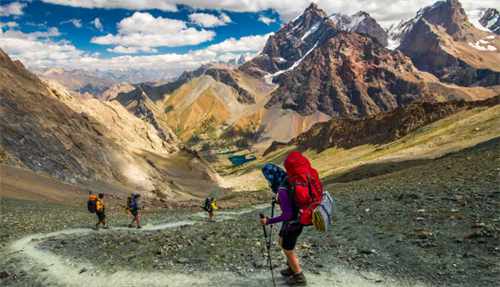
Spring snow hiking — roughly March through May in the Northern Hemisphere — has a way of fooling you. You set out in the morning on crusty ice, hit a shaded slope at midday that turns into collapsing wet glop, and then, on the way down, walk over refrozen patches so transparent they might as well be wet rock.
In conditions like these, picking the wrong traction device isn’t about discomfort. It’s about losing control and sliding.
The two most common choices are lightweight devices usually called microspikes or ice cleats, and the more serious option: crampons. Trek for Trevor, in its February 2026 safety guide Microspikes vs. Crampons vs. Snowshoes: What to Use & When, stated it plainly: “Crampons and microspikes are different tools for different jobs, not interchangeable substitutes. Crampons can do everything microspikes can do and more, but not the other way around.”
That idea comes up again and again — not as theory, but as the backdrop for every decision you’ll make on a spring trail.
This isn’t a brand comparison or a best-buy list. It’s a reference guide to help you judge conditions more objectively during the freeze-thaw season. The information here is drawn from publicly available industry reviews, safety organizations, and outdoor magazines. It’s evidence-based where possible, but when it comes to your specific route, the final call still depends on what you see underfoot that day.
1. Two Tools, Real Differences
1.1 Microspikes: Teeth for Your Boots
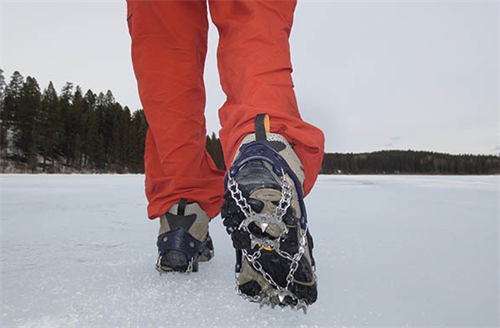
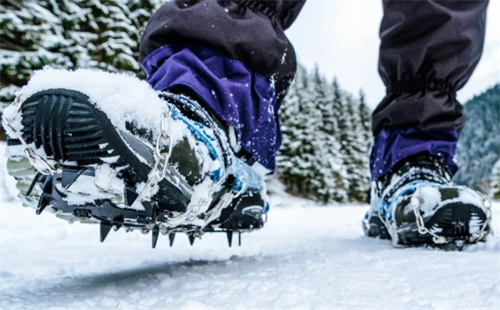
At heart, a microspike is pretty simple: an elastic harness, usually rubber or a TPU blend, stretched around your boot with short metal chains and spikes underneath. The idea isn’t to bite deep into ice, but to create extra sharp contact points that boost friction on hard snow and slick surfaces.
Spike length tends to sit between 8 mm and 12 mm, and the material is often hardened stainless steel or plain carbon steel.
Treeline Review’s February 2026 roundup, 6 Best Winter Traction Devices of 2026*, tested ten devices in the field and gave top marks to the Black Diamond Distance Spike. That model uses 14 heat-treated stainless steel spikes, each only 8 mm long. The pair weighs about 220 grams. Those numbers are small — and that’s the point.
On the other end of the microspike spectrum, something like the Hillsound Trail Crampon Ultra packs 18 spikes, with the heel spikes reaching about 17 mm (roughly ⅔ of an inch), plus a Velcro strap for extra security. Even within the “microspike” category, the range is wide, as Treeline Review’s test data illustrates.
There’s another distinction worth mentioning. Entry-level coil or stud-style devices work very differently from chained spikes like Kahtoola MICROspikes. The former are better suited to icy sidewalks or flat forest paths. When trails get tilted and mountain-y, their grip becomes notably less reliable. Trek for Trevor’s 2026 guide notes that some low-profile cleats with small studs “are rarely the best choice on mountain trails, even though their light weight and compact size look tempting.”
1.2 Crampons: Bite, Not Friction
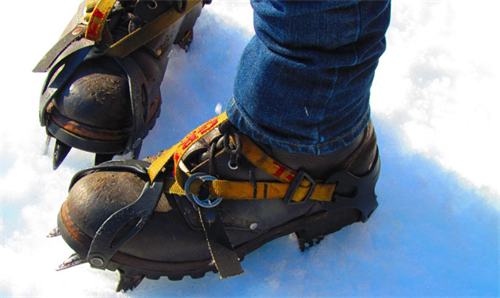
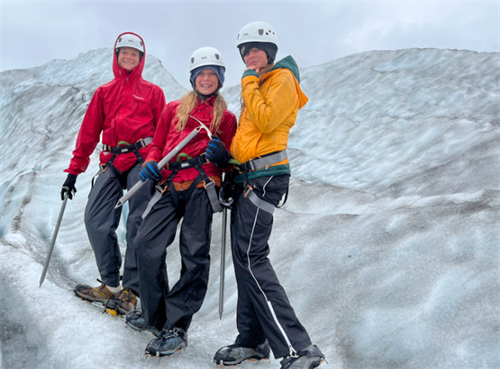
Crampons don’t rely on friction in the same way. They rely on penetration. A typical model has ten or twelve downward-pointing spikes, usually 25 mm (about an inch) or longer, plus two front points that let you kick into snow on steep slopes — a trick microspikes simply can’t do.
Tom Weston, a winter mountaineering instructor at Glenmore Lodge, explained the difference in his 2025 article Crampons vs Microspikes: A Winter Mountaineering Instructor Settles the Debate, published in The Great Outdoors magazine. It’s partly the longer spikes, sure. But the more critical factor is the attachment system. Crampons use strap bindings (C1), clip-and-strap combos (C2), or full step-in bindings (C3). That setup resists displacement under heavy loads, while a microspike basically relies on the tension of a big rubber loop.
Weston put it simply: “They have a secure attachment — either straps for C1, or clips plus straps for C2 and C3.” That difference becomes decisive as the slope angle increases.
1.3 This Isn’t About Labels
You’ll sometimes see the phrase “trail crampons” online, used to describe certain spiky traction devices. It’s a fuzzy term that can make people think they’re getting near-crampon performance. Grouping them together as slight variations of the same thing is where the trouble starts.
The British Mountaineering Council (BMC), in its Walking Boots, Crampons and Micro Spikes guide, defines crampons as “a set of metal spikes that can be fixed to boots to provide greater security when walking on snow and ice.” That phrase — greater security — does a lot of work. It’s not just about adding a bit of grip.
2. Spring’s Hidden Problem: The Freeze-Thaw Cycle
2.1 Crust and Black Ice
Spring isn’t “easier because there’s less snow.” It’s often the trickiest season. Daytime warmth turns the surface into slush. At night, temperatures drop back and that water refreezes into a hard crust. Hikers frequently call it “spring crust,” driven by the freeze-thaw cycle.
In online discussions among Pacific Crest Trail and John Muir Trail hikers, a pattern keeps surfacing: mornings can leave the snowpack “hard and slick enough to require traction devices,” as one common observation goes.
And then there’s black ice. Near the treeline or in rocky zones, meltwater refreezes on stone and creates a nearly transparent layer — it reads like damp rock to the eye until your foot lands and finds nothing to hold.
What makes this even more deceptive is the time-of-day split. You can be on soft snow at 11 a.m. and still hit hard ice on a shaded pitch at 2 p.m. In spring, route planning needs that variability baked in.
2.2 Where Microspikes Start to Fail
On flat or gently angled packed snow, a well-made microspike works fine. That’s the whole reason it exists. The trouble creeps in when the ground tilts.
Weston’s 2025 analysis gets specific: the spikes on a microspike “are fixed to a large rubber ring, which can move under load,” and “the points often don’t extend to the edge of the boot.” Picture a hardened spring slope early in the morning. Only the front part of your foot digs in. Because the spikes are short and the harness flexes, the whole setup can start skidding sideways. If the runout below is rocky or drops into an icy gully, that single slip could be serious.
UKClimbing issued a related safety note in February 2025, titled Microspikes vs Crampons — Safety Advice Issued. It pointed out that some microspikes with front straps can actually pull the heel spikes out of position if not rigged carefully — making them “particularly unsuitable” for steep terrain.
The failure point isn’t that the microspike is bad. It’s that the situation demanded a crampon.
3. A Decision Framework That Doesn’t Rely on Gut Feel
3.1 Four Questions to Ask Yourself
Before you head out, or even mid-hike, these four questions can help you decide:
What’s the dominant snow surface like? Packed snow with a few patches of ice, or a solid crust that alternates with hard ice? The first might lean microspike; the second, crampon.
How steep does it get? Are there side-hill traverses? You don’t need a precise number of degrees. You just need to notice the stretches that make your pulse rise.
If you slip, what are the consequences? Would you slide into rocks, a cliff band, or the base of an icefall?
Where are we in the freeze-thaw cycle right now — hard ice phase or softening slush phase?
These questions don’t form a neat formula. But they’re quicker and often more useful than looking up a gear matrix.
3.2 Where Microspikes Make Sense
Flat to moderately angled icy paths, hard-packed snow trails, and routes where you get ice patches but mainly walk on dirt and gravel — these are microspike territory. They are not for steep slopes, near icefalls, on exposed traverses, or anywhere you might need to kick a front point into firm snow.
Weston draws the line like this: if anywhere on the route a fall means you’ll slide, microspikes probably aren’t the right tool. He says their safe zone is “where it’s certain that a fall wouldn’t result in a slide.”
3.3 When to Switch to Crampons
Trek for Trevor’s 2026 guidance is straightforward: whenever conditions demand more grip than microspikes can provide, consider crampons.
Spring often throws in a mixed bag — soft snow with hidden ice layers. That’s where crampons bring real peace of mind. But it’s worth noting that carrying crampons and being able to use them safely on a hard slope are two different things. Self-arrest skills and an ice axe are part of the equation on steep, firm snow, and not every hiker has that training. Even with the right gear, exposure remains a serious risk if the skills aren’t there.
4. Boots — The Overlooked Part of the Equation
4.1 Why B0 Hiking Shoes and Crampons Don’t Mix
The British Mountaineering Council classifies boots from B0 to B3. A B0 boot is basically a three-season hiker — flexible, comfortable, like a Salomon X Ultra or Merrell Moab. When you strap a crampon onto a sole that bends easily under pressure, the crampon can shift or even pop off. The BMC labels B0 boots “not suitable for use with crampons” in its official boot guide.
The Hiking Tribe, in its 2026 compatibility guide The Boot-Crampon Pairing Mistake Every Hiker Makes, put it even more plainly: most B0 boots aren’t compatible with standard crampons. You need at least a B1 boot with a semi-stiff sole to use C1 strap-on crampons safely. The guide describes a B1 as suitable “for lower-altitude shoulder-season routes where you might hit short ice patches, not for all-day ice travel.” So even upgrading to B1 doesn’t give you a free pass into every frozen bowl.
4.2 Checking Compatibility Yourself
A practical check: mount the crampon, then grab the boot with both hands and twist, mimicking the forces of a stride. If the frame wobbles or the heel lifts, that’s a problem.
For microspikes, look at whether the rubber harness fully wraps the sole and whether the chains are pulling to one side. Off-center chains often mean poor fit, which raises the risk of the device coming off under heavy use.
Most microspikes are designed to work with a wide range of hiking shoes and boots, and even some trail runners. Treeline Review’s 2026 testing found the Black Diamond Distance Spike performed consistently across different footwear types. But that doesn’t mean you can take them where only crampons should go.
5. A Quick Word on Snowshoes
Snowshoes deserve a mention because people sometimes treat them as traction devices in spring. They’re not. Snowshoes are for flotation in deep, soft powder — not for grip.
Trek for Trevor’s 2026 guide makes the point that snowshoes don’t solve sliding problems, and their teeth can actually be inadequate on harder spring surfaces.
The rule of thumb: if snow depth is expected to top 20–30 cm and the snow is still soft, snowshoes earn their keep. In freeze-thaw conditions, that hard crust often means you can walk on top without them, so many experienced hikers leave the snowshoes at home and carry microspikes or crampons instead.
6. Buying and Maintaining — Practical Stuff
6.1 What to Look For
A few things to focus on: spike material (heat-treated stainless tends to resist rust, carbon steel is tougher but needs care), spike length, the sturdiness of the harness and straps, and whether you can put them on while wearing thick gloves.
SectionHiker’s 2025 review, Black Diamond Distance Spikes Traction Device Review; Hillsounds or Microspikes? How to Choose, pointed out that the Hillsound Trail Crampon Ultra includes a Velcro strap that wraps over the boot for extra security — a small detail that makes a meaningful difference in preventing accidental loss.
6.2 Maintenance and Lifespan
The principles aren’t complicated. Dry fabric and elastic parts after each use. Check the rubber for cracks or aging — this kind of wear accumulates gradually over seasons and is often visible to the eye. When spikes wear down by about 40% or more, grip drops noticeably.
SectionHiker’s 2025 review also mentions you can try sharpening spikes with a file, but adds, “the metal isn’t high-grade enough to hold an edge for long.” If a chain link breaks, replacing the unit is usually smarter than trying to patch it.
FAQ
Q: Can I just use crampons everywhere instead of microspikes?
In terms of grip, crampons cover almost any snow and ice surface. But walking on rock or pavement will dull the points fast, and heavy crampons on a gravel path can increase your tripping risk. Weight and convenience matter, too.
Q: Can I put semi-automatic crampons on B1 boots?
By UIAA compatibility rules, B1 boots are generally meant for strap-on crampons (C1) only. Semi-automatic crampons (C2) rely on a heel welt, which usually shows up on B2 boots or stiffer. Forcing a mismatch carries real safety risks.
Q: I’m heading to a mid-altitude Alpine route in May. What do I bring?
Depends heavily on the forecast and route profile. A maintained trail with hard snow and no serious slope? Microspikes might do the job. If there are sustained steep sections or frequent refreezing, carrying crampons is more cautious. Day-of snow reports are usually the deciding factor.
Q: Are microspikes okay on trail runners?
Some models are compatible — the Black Diamond Distance Spike, according to Treeline Review’s 2026 test, has a design that fits ultralight shoes. But that setup assumes mild slopes and consequences, not technical terrain.
Q: What about ultralight aluminum crampons for hiking?
They’re lighter, but aluminum wears down faster than steel. The BMC notes in its crampon guide that aluminum crampons are often “not designed for UK or mixed conditions,” and they struggle on routes that mix rock and hard snow. In spring, where bare rock patches are common, steel is generally safer.
References
[1] Forrest, A. (2026). 8 Best Anti-Slip Microspikes and Ice Grippers/Cleats for Shoes and Boots in 2026.Walks4all.
[2] Treeline Review. (2026). 6 Best Winter Traction Devices of 2026 (Tested & Reviewed).
[3] Weston, T. (2025). Crampons vs Microspikes: A Winter Mountaineering Instructor Settles the Debate. The Great Outdoors Magazine.
[4] Trek for Trevor. (2026). Microspikes vs. Crampons vs. Snowshoes: What to Use & When.
[5] UKClimbing. (2025). Microspikes vs Crampons — Safety Advice Issued.
[6] British Mountaineering Council (BMC). Walking Boots, Crampons and Micro Spikes.
[7] The Hiking Tribe. (2026). The Boot-Crampon Pairing Mistake Every Hiker Makes.
[8] SectionHiker. (2025). Black Diamond Distance Spikes Traction Device Review; Hillsounds or Microspikes? How to Choose.
[9] CleverHiker. (2025). Black Diamond Distance Spike Traction Device Review.
[10] UIAA Safety Commission. UIAA Safety Standards for Mountaineering and Climbing Equipment.
Disclaimer
This article is for educational and informational purposes only and does not constitute professional mountaineering advice or a guarantee of safety. Snow hiking, mountaineering, and related activities carry inherent risks that can result in serious injury or death. Readers are responsible for assessing their own fitness, skill level, and the on-site conditions, and should seek professional guidance when appropriate. Equipment standards (such as UIAA certifications) referenced here were current at the time of publication but may change over time. When purchasing gear, always check the latest specifications. The author and publisher assume no liability for any direct or indirect loss arising from the use of this information.
Recommend for you:
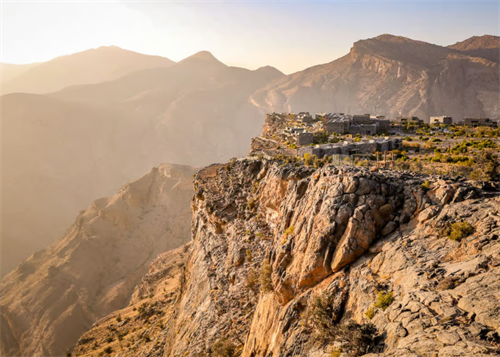
Trekking Oman's Hajar Mountains: Canyons and Ghost Villages
In northern Oman, under the shadow of limestone cliffs, there are stone villages where half the roofs have caved in. They don't show up on the main pages of most conventional guidebooks.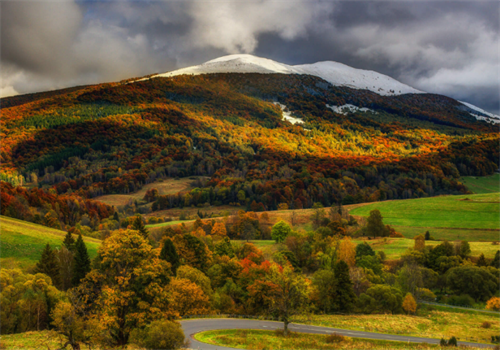
Bieszczady: Poland's Remote Eastern Wilderness
The Bieszczady Mountains sit at Poland's southeastern corner, bordering Slovakia and Ukraine.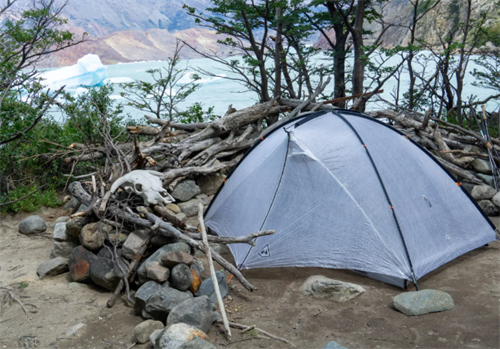
The Ultralight Holy Grail: Sub-2-Pound Tents Built With Graphene and Super-Polymers
In the fall of 2025, ALUULA Composites put out a low-key but telling announcement through Newsfile Corp. The company had shipped its first 1.5-metre-wide, 24 g/m² ultra-light composite fabric to a handful of brand partners.
Mycelium-Based Gear: How Mushrooms Are Becoming the Future of Hiking Equipment
By 2026, mycelium leather isn't just a lab curiosity anymore.