
Canister Stove vs. Liquid Fuel Stove: Which Cooking System for High-Altitude Trekking?
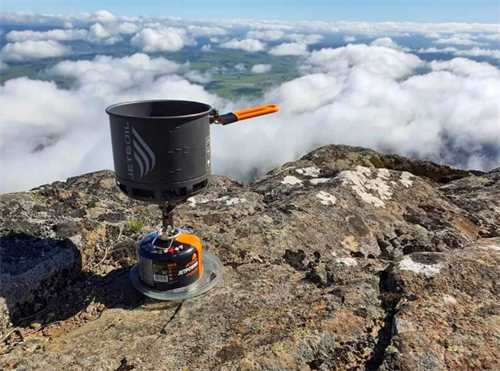
Author: Mark R. Vance| Release date: May 9, 2026 | Reading time: ~18 minutes
Author Background: Mark R. Vance writes about hiking equipment, backpacking systems, and mountain safety practices. His work focuses on how gear performs in real-world trail conditions, especially on long-distance routes, rocky terrain, and cold-weather hikes. Rather than concentrating on product marketing, he analyzes practical trade-offs involving weight, durability, comfort, and reliability. His articles often explore footwear systems, layering strategies, navigation tools, and emergency preparedness for independent hikers. Drawing from years of trekking experience and outdoor research, he aims to explain technical outdoor topics in a clear and accessible way for both newer hikers and experienced backpackers.
When you're walking a ridgeline at 4,000 meters carrying a week of gear, choosing a cooking system isn't just about making fire — it's a quiet argument with physics. Pressure drops. Temperatures swing. The fuel inside your pack behaves nothing like it does at sea level. Decisions made days or weeks earlier, at home, suddenly play out in real time.
1. The physics of fuel — why "cold" isn't the whole story
1.1 What happens inside a canister
A canister stove's weak spot is vapor pressure. Fuel sits inside as liquefied petroleum gas. It has to turn into vapor before it can burn. And that depends heavily on temperature — more precisely, on the boiling points of whatever blend is in the can.
MSR publishes the sea-level boiling points of the three common LPG components in its IsoPro fuel documentation: propane at roughly -44°F (-42°C), isobutane around 11°F (-12°C), and n-butane about 30°F (-1°C). N-butane, near freezing, barely vaporizes. That's why cheap canisters heavy on butane give up early in cold weather. MSR's IsoPro blend uses 80% isobutane and 20% propane; according to the manufacturer, manufacturing tolerances allow up to 6% n-butane, though it's typically kept below 2%.
Then there's the self-cooling effect: as fuel vaporizes, it pulls heat from the canister body, making it colder. Run the stove continuously, and the canister temperature can fall well below ambient. It's a slow-moving negative feedback loop that eats into performance the longer you simmer.
1.2 The double effect of high altitude
One thing doesn't get said enough: altitude pushes in two directions at once.
Low ambient temperatures drag down vapor pressure inside the canister — that's the downside. But lower atmospheric pressure outside the canister actually makes it easier for liquid fuel to vaporize, which partly offsets the cold penalty. On some summer Alpine routes around 4,000 meters, the air might be cool but not frigid, and the stove may perform no worse than at lower elevation in deep winter.
SOTO's official guide offers a rough threshold: when ambient temperature drops below 10°C (50°F), they suggest switching to a canister with a higher propane ratio. Once temperatures stay reliably below freezing, the guide points users toward white gasoline. Some stoves with built-in pressure regulators can stretch this further — SOTO literature states that certain regulated models maintain stable output at 2,800 kcal/h with a four-season canister down to around -5°C (23°F). But that's a limit, not a cure-all.
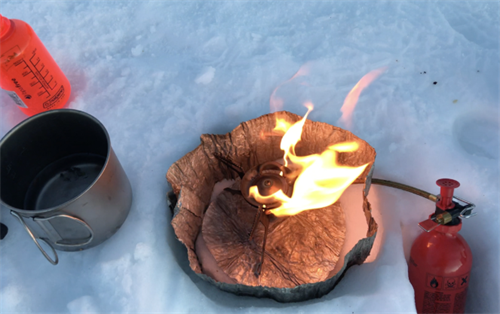
For context: industry sources and technical guides note that liquid fuel stoves will burn at temperatures as low as -40°F (-40°C), making them a more reliable choice in sustained deep cold.
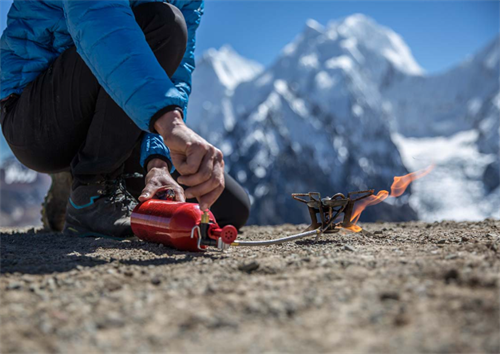
2. How different stove designs handle the cold
2.1 Remote canister stoves and liquid feed
Some remote canister stoves include a preheat tube. This design lets you invert the canister and feed liquid fuel straight into the tube, where it vaporizes before hitting the burner — bypassing the vapor-pressure problem altogether. In deep cold, that can make a real difference.
But there's a hard rule: only do this if the stove manual explicitly allows inverted canister operation. If the stove isn't built for it, liquid fuel can reach the burner before vaporizing, causing a flare-up that's dangerous and hard to control. That's not a hypothetical concern — it's a known cause of tent-vestibule accidents.
Remote systems also keep the canister farther from the flame, which is marginally safer. The trade-off is weight. These setups are usually heavier than an integrated canister stove, and the extra hose plus fittings add a little complexity. There's no single number that applies across all models.
2.2 How a liquid fuel stove works — and where it actually wins
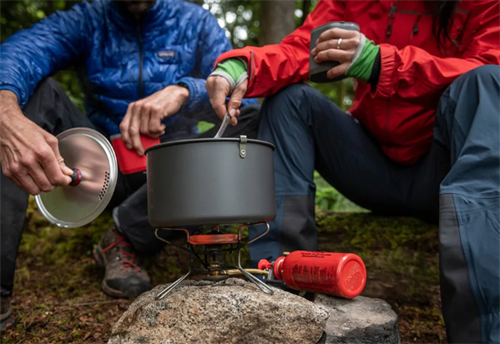
A liquid fuel stove runs on different logic. You manually pressurize the fuel bottle with a pump. Liquid fuel — white gas, kerosene, whatever — is pushed into a generator tube where heat turns it to gas before it reaches the burner. Since you control pressure, the system doesn't lean on ambient temperature the way a canister does.
But that's not the same as saying a liquid stove always outperforms at altitude. Starting one in extreme cold still requires a slow, deliberate priming step; rush it and you get soot, yellow flames, wasted fuel. Once it's going, you often need to pump again to maintain steady pressure. The pump cup seal wears over time and needs replacement — routine stuff, but easy to forget.
The real advantage of a liquid fuel stove shows up most clearly in sustained deep cold, below about -10°C (14°F), not in every high-altitude scenario. Above that threshold, the performance gap between the two systems often narrows — and user skill becomes the bigger variable.
3. The weight equation: where the break-even point sits
3.1 Empty canister vs. empty bottle
Comparing stove head weight alone misses the picture. A canister stove head might weigh 40-90 grams; a liquid fuel stove head often lands between 250 and 450 grams. But the real story is in the fuel and its container.
A disposable canister is a thick steel vessel built to hold pressure. Even empty, a typical 230 g canister adds a deadweight that various outdoor gear resources put at roughly 100-140 grams, though this varies by brand and canister size. A reusable 11-ounce fuel bottle, by comparison, is lighter when empty — and can be refilled thousands of times.
The deadweight penalty of canisters multiplies when you carry backups for a longer trip. With a liquid fuel bottle, you take exactly the fuel you need and no more.
3.2 Short trip vs. long trip
For 3-5 day trips, a 110 g or 230 g canister usually covers one person. Add a featherweight stove, and the total system weight is unquestionably lower than a liquid fuel setup. But the math shifts when you're out for a week or more. A rule of thumb that appears widely in backpacking forums — not a hard calculation, but useful enough — suggests the break-even sits somewhere around 7-10 days. After that, a liquid fuel system often ends up lighter overall.
Why? Liquid fuels pack more heat per unit weight, and you stop carrying the accumulated deadweight of multiple empty canisters. Himalaya Gears, in published material, states that one liter of gasoline roughly matches the burn time of three 220 g gas canisters — a ballpark comparison that naturally shifts with stove efficiency, altitude, and wind, so treat it as a rough estimate, not a formula.
4. Global fuel availability — the practical dealbreaker
4.1 Where canisters are — and aren't
According to Cascade Designs' (MSR's parent company) global fuel availability guide, threaded EN417 canisters are generally available in North America, all of Europe, major Patagonian trail towns, Nepal's Khumbu region, mountaineering hubs in Pakistan, and parts of South Africa and Central America. If you're on a short trip in developed alpine areas, finding a canister is rarely a problem.
But move off that map, and things get patchy fast. In rural parts of Central Asia, the Andes, or Africa, canisters may be unavailable for long stretches. A multi-fuel liquid stove that can run on white gas, unleaded petrol, kerosene, diesel, or even aviation fuel acts as a kind of universal adapter. It's a pattern documented over decades in forums and trip reports: where there's a road, there's usually at least one of those fuels.
4.2 The hard rule of air travel
Airlines leave no room for interpretation: gas canisters are never allowed — not in carry-on, not in checked baggage. Empty fuel bottles must be completely drained and the cap left open. You'll need to buy fuel at your destination. That makes checking local supply before booking the final-leg flight non-negotiable.
5. Fire regulations — equal treatment, with few exceptions
5.1 Legally, they're the same thing
From a public lands perspective, canister stoves and liquid fuel stoves are almost always treated identically. Both qualify as "contained fuel stoves." When fire restrictions roll out in dry seasons, wood and charcoal fires get banned; portable gas or liquid-fuel stoves usually stay permitted.
Consider U.S. National Park Service documents from 2025. Lake Roosevelt National Recreation Area issued partial fire restrictions that prohibited all fires on park-managed lands but explicitly allowed "self-contained propane or gas cookstoves and lanterns". When the ban was elevated to total restrictions, the NPS order still exempted self-contained propane or gas cookstoves and lanterns. Colorado National Monument publishes year-round restrictions covering "properly shielded gas or liquid fuel portable camping stoves" without drawing a distinction between the two.
Nevada State Parks uses similar language. Under Stage 1 fire restrictions, the following is prohibited: "Building, maintaining, attending, or using a fire... except a portable stove using gas, jellied petroleum, or pressurized liquid fuel". Under Stage 2 restrictions, the same exception applies. Both systems fall inside the same regulatory box.
5.2 The edge cases
In extreme fire danger, even these exemptions can narrow. The Lake Roosevelt total fire restriction in 2025 banned all fires, including those in NPS-provided fire rings and barbecue boxes, leaving only self-contained gas stoves and lanterns. That's not the norm — but it's a real example of how high-risk conditions can tighten the rules. Checking the current fire order for your destination is always the right move. Last season's rules are not a reliable guide.
6. The environmental cost — a dimension that gets sidelined
6.1 The recycling gap for canisters
Disposable gas canisters have a waste problem that's worse than many trekkers realize. In theory, they're steel and recyclable. In practice, you need to fully vent them, puncture them, and then find a facility that accepts punctured pressurized containers. Most curbside programs won't take them as-is.
Jetboil makes the CrunchIt tool, which vents and punctures canisters safely to prepare them for recycling. The manufacturer's product page notes alongside the tool that recycling rules vary by location and users should check with local waste management. But checking compliance doesn't guarantee the canister actually gets recycled — that depends on how each local facility handles the material. No current, independently verifiable data on exactly what percentage of single-use fuel canisters ends up in landfills appears to be publicly available from a named source. Available industry discussions suggest the rate is significant, but precise figures are hard to pin down.
6.2 The refillable advantage
Liquid fuel bottles can be refilled thousands of times. Per use, they generate far less waste. Both systems produce steel waste at end-of-life, but the liquid bottle's waste stream over its lifetime is considerably lighter.
For hikers who take Leave No Trace seriously, that difference matters. But flattening it to "liquid fuel stoves are definitely greener" would be dishonest. Spills during refilling, the production footprint of each system, and the disposal of worn pump parts all complicate the math. Even so, the weight of evidence tilts toward refillable systems as the lower-waste option over the long haul.
Where this leaves you — a framework, not a scorecard
Here's how the evidence comes together. Use it as a loose sorting tool, not a rigid prescription.
Summer alpine trips of 3-7 days in North America or Europe, with temperatures mostly between 5°C and 30°C (40°F-85°F) and reliable resupply — a lightweight canister stove is usually the simpler, more efficient choice. Picking a four-season canister with a high propane blend (like an 80/20 isobutane-propane mix) gives a buffer against unexpected cold snaps.
Winter ice climbing, polar traverses, or routes consistently above 4,500 meters where temperatures stay well below -10°C (14°F) — a liquid fuel stove tends to offer more stable output, because it doesn't lean on ambient temperature to vaporize fuel. But this advantage assumes one thing: you've practiced lighting and maintaining it in those conditions.
Remote expeditions of two weeks or more in Central Asia, the high Andes, or interior Africa — fuel availability often becomes the deciding factor. A multi-fuel liquid stove that can run on whatever is sold at the nearest roadside stall gives you flexibility canisters can't match.
If you're torn between weight and redundancy — a not-uncommon strategy on group trips is to carry a small canister stove for daily meals and a single liquid fuel stove as a shared backup for the coldest camps.
If your trip involves air travel — empty your fuel bottle, leave the cap open, and plan to buy fuel locally. Gas canisters are a non-starter at any security checkpoint.
These aren't universal truths; they're patterns drawn from published sources. Actual conditions vary, sometimes a lot. Your own stove model, your exact route, and your tolerance for tinkering will tilt things one way or the other.
FAQ:
Q: Can I still use a canister stove above 4,000 meters?
Yes, with conditions. If you're using a four-season canister with a high propane ratio and temperatures aren't consistently below freezing, it usually works. But if it's both cold and high, performance drops noticeably, and a liquid fuel stove typically delivers steadier heat.
Q: Is it safe to cook inside the tent with a liquid fuel stove?
Strongly not recommended. The priming step can produce a large yellow flame, and the risk of a fuel spill is higher than with a canister stove. If you absolutely must cook in a vestibule, make sure there's plenty of ventilation, keep the stove low and away from walls, and have a way to smother a flare-up immediately. Outside is better.
Q: How much hassle is liquid fuel stove maintenance, really?
The steps themselves are simple: disassemble the jet, clean out carbon with the included pricker, replace the pump cup seal every year or two. The catch is you need to practice this at home. Doing it for the first time with cold fingers after a long day is no fun.
Q: Any tricks for using a canister stove in colder weather?
A few. Keep the canister in your sleeping bag overnight. Use a remote canister stove that allows inverted canister operation (liquid feed) — but only if the manufacturer says that's safe. Put a thin foam pad under the canister to slow heat loss to the ground. None of these turn a summer canister into a winter workhorse, but they can extend your operating window a bit.
References
[1] MSR / Cascade Designs. What type of fuels are in MSR IsoPro canisters? 2025. https://support.cascadedesigns.com/hc/en-us/articles/35377027303059
[2] SOTO Outdoors. SOTO Micro Regulator Stove Windmaster SOD-311GS. 2026. (via wildholics.com)
[3] MSR / Cascade Designs. Fuels Around the World: Finding Stove Fuel In A Foreign Country. 2024. https://cascadedesigns.com/de-eu/blogs/msr-gear-guides/stove-fuels-around-world-finding-stove-fuel-foreign-country
[4] National Park Service. 2025 partial fire restrictions implemented – Lake Roosevelt National Recreation Area. June 11, 2025. https://home.nps.gov/laro/learn/news/2025-partial-fire-restrictions-implemented.htm
[5] National Park Service. 2025 total fire restrictions implemented – Lake Roosevelt National Recreation Area. June 26, 2025.
[6] Nevada State Parks. Fire Restrictions. Updated October 1, 2025. https://parks.nv.gov/about/fire-restrictions
[7] Jetboil. CrunchIt Fuel Canister Recycling Tool. 2025. https://jetboil.johnsonoutdoors.com
[8] OutdoorGearLab. The Best Backpacking Stoves. 2025. https://www.outdoorgearlab.com
[9] St. Croix Winter Ultra. Let's talk about stoves. October 30, 2020. (via stcroixwinterultra.com)
[10] Himalaya Gears. Published fuel comparison data.
Disclaimer
This article is intended for outdoor education and information only and does not constitute a safety guarantee or professional gear recommendation. Outdoor activities carry inherent risks, and cooking system choices should be guided by specific trip conditions, personal skill levels, and the manufacturer's instructions. Any brand, model, or product name mentioned is cited solely for reference and does not imply endorsement. Fuel availability, regulations, and recycling policies can change without notice; always verify current conditions through official sources before your trip. The author and publisher assume no legal responsibility for any direct or indirect consequences that may arise from using this information.
Recommend for you:
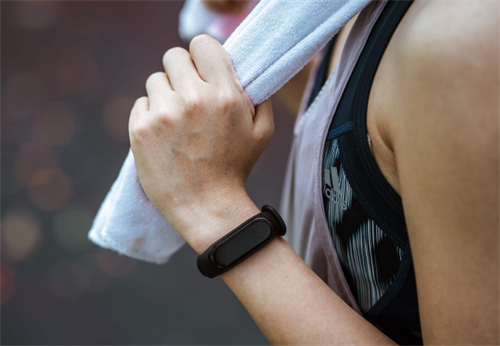
Sweat-Powered Wearables: The Next Frontier in Off-Grid Charging
Few hikers talk about it, but one slow-burning frustration hits hardest on long trips: battery anxiety.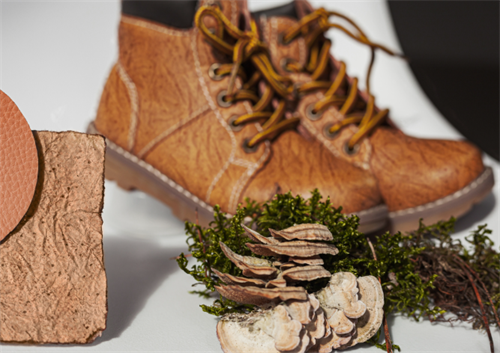
Mycelium-Based Gear: How Mushrooms Are Becoming the Future of Hiking Equipment
By 2026, mycelium leather isn't just a lab curiosity anymore.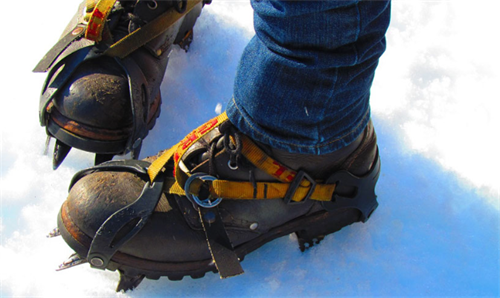
Crampons vs. Microspikes: What You Need for Spring Snow Hiking
Spring snow hiking — roughly March through May in the Northern Hemisphere — has a way of fooling you.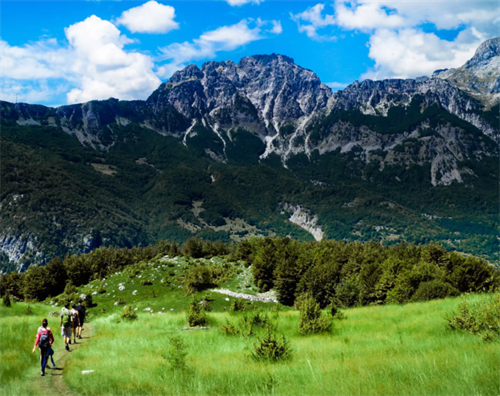
Hiking the Accursed Mountains: A Complete Guide to Northern Albania
Online information about northern Albania’s Bjeshkët e Nemuna – often called the Accursed Mountains – tends to fall into two camps.