How 3D-Printed Trail Food Might Change Your Backcountry Cooking Menu
By Michael J. Reynolds| Release Date: May 10, 2026 | Reading Time: 11–13 minutes
Author Background: Michael J. Reynolds is a technology and outdoor systems writer covering the intersection of hiking, mobility, wearable devices, and emerging expedition technologies. His articles examine how developments such as satellite communication, AI-assisted rescue systems, advanced materials, and portable energy solutions are beginning to influence outdoor travel and backcountry safety. He is particularly interested in the practical impact of technology on self-supported trekking and wilderness experiences rather than speculative marketing claims. His work combines industry reports, product research, and long-form analysis to explore how outdoor equipment and mountain travel may evolve over the coming decade.
Backpacking food hasn’t changed much in decades. You’ve got freeze-dried pouches, energy bars, oatmeal, nuts with chocolate. They pack calories, weigh little, and last forever. But exciting? Not really.
A technology originally developed for hospitals and space programs is now edging into stranger corners: 3D food printing. A review published in May 2026 in the Journal of the Science of Food and Agriculture explains that 3D food printing merges digital manufacturing, materials science, and nutrition. It builds edible structures layer by layer, controlling shape, texture, and nutritional content along the way. According to this review, the list of printable ingredients now goes far beyond chocolate and dough — it includes plant-based proteins, alternative flours, and nutrient-enriched formulations.
That sounds promising. But getting this tech out of a glossy test kitchen and into your pack, to a windy ridge where your stove is struggling, is a whole other story.
There are serious, rarely discussed hurdles. This guide walks through what 3D-printed food can and can’t do right now for hikers, based on publicly available research and industry reports. And it asks whether — or when — it might actually change the menu you stare at during your next trip.
1. Three Printing Methods — Only One Really Matters for Hiking
To understand the possibilities, you need to know how these machines work. There are three main printing technologies, but their relevance for trail food differs dramatically.
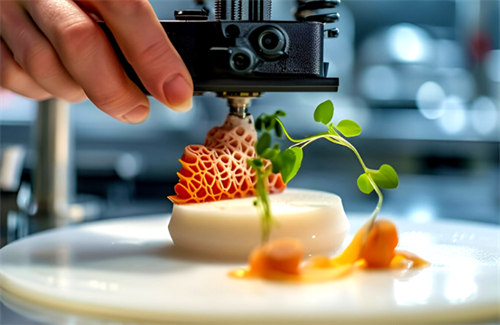
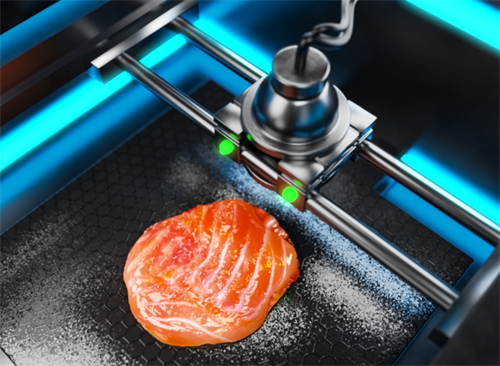
Extrusion-based printing is the most common. Imagine ingredients turned into a paste or dough, pushed through a nozzle, and deposited in layers. Plant proteins, carbohydrates, fats — all can be handled this way. A 2026 review in the journal Sustainable Food Technology looked specifically at plant-based protein materials for 3D printing and detailed the flow challenges — how the material must thin under pressure then set firmly once printed, and how different pastes behave inside a single nozzle. Extrusion’s big advantage for hiking is that the raw material form — slurries and powders — is already the foundation of most trail food. If any printing method shows up first in an outdoor food factory, it will likely be extrusion.
Binder jetting sprays a liquid binding agent onto a powder bed to glue it together. It can achieve fine detail, but getting consistent texture and speed with high-protein mixes remains tricky.
Selective laser sintering (SLS) uses a laser to fuse powdered ingredients. It can produce crunchy, brittle structures, but the intense, localized heat risks degrading some nutrients before the food is even eaten.
For hiking purposes, keep your eye on extrusion. The other two will probably stay in other industries for quite a while.
2. Three Old Problems, One New Approach
Why are food scientists and a few gear researchers paying attention to 3D printing? Because it takes aim at three persistent frustrations every long-distance hiker knows. But let’s be clear: the following is based on lab findings, not store shelves. The gap between lab and trail is still wide.
The taste-vs-weight-vs-nutrition grind. Eating the same oatmeal and instant pasta for five days straight gets old fast, even when you’re burning 4,000 calories a day. The usual fix is to carry multiple meal pouches — more weight, more bulk. 3D printing works differently: instead of switching finished products, you tweak the recipe parameters on the same base materials. Small changes in the printing file produce different flavours and mouthfeels without entirely separate production batches.
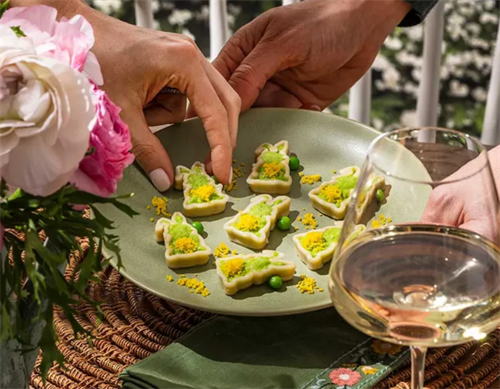
An example from Italy’s ENEA research agency: their Nutri3D project turned lab-grown plant cells and fruit-processing by-products into printable “inks,” then printed high-nutrient snacks — pastries, bars, and little spheres they called “honey pearls.” ENEA also surveyed 400 people and found that 59% were willing to try such food, though some still viewed it as “unnatural,” a perception the researchers linked to cultural and informational barriers. This wasn’t a wilderness test, but the core idea — variety from a minimal ingredient set — lines up with what backpackers need.
The calorie-to-gram wrestling match. To a thru-hiker, every gram counts. Traditionally you swap carbs for fat to raise energy density. 3D printing adds a new lever: microstructure. By precisely controlling tiny pores and moisture content, you can adjust the physical density and rehydration speed of food without changing its ingredients. A 2025 study in the journal Food Hydrocolloids demonstrated that simply altering the extrusion temperature of plant-based meat analogues could increase the product’s resistance to structural breakdown by about 50%. Same ingredients, different physical behavior. That’s a level of tuning conventional processing can’t easily reach.
Dietary restrictions with almost zero options. Gluten-free, dairy-free, nut-free, vegan — tricky enough in town, potentially impossible on a remote trail. 3D printing’s programmed control over ingredient flow means you could, in theory, keep different formulations strictly separated on the same machine, reducing cross-contamination risk. The 2026 review by Selvaraju and colleagues also noted that the technology opens a door to personalized nutrition for individual needs and health profiles. But that door only opens as far as real-world production protocols allow. It’s not an automatic guarantee.
3. Who’s Making Grab-and-Go Printed Food — and Who Isn’t
Products and technology are often miles apart. Some companies already sell 3D-printed edibles, but none are designed for backpacking.
The UK brand Nourished offers a useful reference point. Founded by Melissa Snover in 2019, Nourished uses patented 3D printing to produce personalized vegan nutrient gummies. You fill out a short online questionnaire; an algorithm selects a blend of 7 active ingredients from 35 options; the machine prints each gummy as seven distinct layers.
As reported by multiple UK outlets in 2025, Nourished secured a £9 million funding round led by the West Midlands Co-Investment Fund and others to expand production and international reach. The company also booked £6.35 million in revenue in 2024 and projected around £10 million for 2025. Its products entered major UK retailers including Boots, Holland & Barrett, and Ocado.
But here’s the catch: these are vitamin supplements, not trail meals. Their packaging, formulation, and shelf-life testing are designed for kitchen cupboards, not sweaty backpacks. The personalization model is worth noting. The product itself doesn’t translate directly.
Redefine Meat from Israel is on a different track. Using AI and industrial-scale printers, it layers plant-based “muscle,” “fat,” and “blood” components to replicate the texture of whole cuts. Their products are served in around 4,000 food-service outlets across more than ten countries, and their Dutch facility reportedly produces 500 metric tons per month. This proves 3D food printing can scale industrially — but a restaurant steak substitute isn’t what you’ll simmer at a campsite.
More relevant, though still in early stages, is military research. The U.S. Army’s DEVCOM published a study in the journal Future Foods in early 2026 that examined how soldiers react to 3D-printed food. Researchers ran focus groups and taste tests with 17 combat medics.
Initial reactions were “broadly negative.” Soldiers worried about the food feeling “artificial” and about eating something “synthetic.” One participant said it “strips food of its essence.” But after the soldiers watched the printing process and tasted bars printed with labels like a lightning bolt and “PWR” or “REST,” their attitudes shifted to what the researchers called “cautious optimism.” An interesting detail: bars printed with those mission-specific icons were about twice as popular as plain ones.
Why was the Army interested? Simple logistics. A soldier on a week-long mission without resupply can carry over 30 pounds (about 14 kg) of food alone. Standard MREs are heavy and can’t match personal metabolic needs. The idea behind printed rations is compact ingredient capsules and on-demand production — a decentralized, tailored supply model that should sound familiar to any long-distance hiker. The same study stressed, however, that print speed, safe ingredient handling, and operator training still need significant improvement.
In the Netherlands, the IMAGINE project, a consortium involving TNO and Wageningen University, demonstrated a mobile kitchen equipped with a 3D food printer. Using personal data — height, weight, body type, gut health, planned exertion — it custom-printed “Nutri-Bites” for individual soldiers, with each tray linked to personal data via a QR code. The equipment was packed into a shipping container, which counts as “portable” for military logistics but not for a backpacker.
So, the blunt answer: as of May 2026, no brand has launched a 3D-printed food product with hiking, camping, or backcountry cooking as the core design scenario. The tough requirements — long room-temperature shelf life, fast field rehydration, extreme temperature tolerance — haven’t been the main R&D targets in food printing yet.
4. The More Precisely You Print, the More Nutrients You Might Lose
Here’s a contradiction the marketing pitch almost never mentions. Extrusion printing typically runs at 40–80°C, with plenty of mechanical shear force pushing ingredients through a tiny nozzle. Heat-sensitive nutrients don’t like that.
A 2025 review in the journal Food and Humanity examined antioxidant stability in 3D-printed functional foods. It found that if thermal and mechanical degradation aren’t carefully managed, the activity of polyphenols, carotenoids, and certain vitamins can drop noticeably. The review outlined three protective strategies: tweaking temperature, speed, and pressure; applying surface coatings or layer-by-layer barriers against oxygen and light; and microencapsulation, which wraps sensitive nutrients in a protective shell.
Microencapsulation has shown promise. A 2025 study in npj Science of Food used coaxial 3D printing to co-encapsulate lutein and anthocyanins. After 21 days stored at 25°C, the encapsulated lutein degraded only 29–55%, while the raw, unencapsulated form degraded 97%. For anthocyanins, encapsulation reduced degradation from 70% to 42–55%. Bioaccessibility also improved: 9.8% for encapsulated lutein versus 1.5% raw, and 37.5% for encapsulated anthocyanins versus 20.3% raw.
So yes, clever engineering can help. But the same 2025 review also flagged that significant research gaps remain around how much of a nutrient the body actually absorbs from a printed matrix, and around scaling such processes up. These are active lab questions. For a hiker on a windy pass, nobody has tested this yet.
5. Packaging, Shelf Life, and Regulations: Three Hurdles You Can’t Skip
Trail food has a brutally practical filter. It needs to sit in a sealed bag for years and still be edible. It must survive being opened at 4,000 meters. It has to hold up in a damp tent without growing mold. And you need to trust every bite.
Today, most printed food packaging is designed for retail shelves and quick consumption. But hiking food demands something different: crush-proof, feather-light packets that can handle UV exposure, pressure swings, and maybe some accidental contact with stove fuel. I have not found any publicly available research testing 3D-printed food packaging under those specific conditions. It’s a genuine blank spot.
Shelf life is an even bigger unknown. Standard freeze-dried trekking meals often claim a shelf life of three to seven years, depending on packaging integrity and storage. 3D-printed foods tend to start as pastes, gels, or highly active mixed matrices — which are theoretically more sensitive to temperature swings and moisture migration. The 2026 Selvaraju review still lists “nutritional stability” as an unresolved core challenge for 3D food printing.
Then there is regulation. In the EU, food produced by a novel process or not widely consumed before May 15, 1997 falls under the Novel Food regulation (EU) 2015/2283. A safety assessment is required before it can be placed on the market. While the statutory time limit for authorization is 18 months, industry experience indicates the actual average is closer to two and a half years, with some cases extending beyond five years. In the United States, the FDA has not created a separate category for 3D-printed food; it evaluates such products within its existing food safety and food-contact materials frameworks. This means the regulatory path for a printed backpacking meal is neither quick nor certain.
6. A Reasonable, Cautious Projection
What follows is not a prediction. It’s a sketch of possibilities based on what’s known today. Every step depends on conditions that may or may not be met.
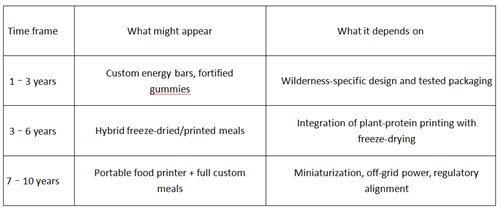
Near term (1–3 years): Personalized nutrient bars might appear as experiments among ultralight backpackers. The logic Nourished uses for vitamins could be adapted to energy bars with some reformulation and new packaging. The U.S. Army study suggests that hands-on experience can shift perceptions. But no brand has announced a dedicated outdoor product line yet, and that would require independent design and testing not currently visible.
Mid term (3–6 years): Blending freeze-drying with 3D printing is probably the most realistic path. Some outdoor food companies are already incorporating plant-based proteins into their traditional freeze-dried lines. If a printed protein layer or nutrient boost were integrated and then locked in with freeze-drying, the technical barrier would be relatively low. The outdoor industry tends to prefer this kind of step-by-step approach.
Longer term (7–10 years): A portable device that prints and cooks your meal at camp? That vision, similar to the integrated printing-and-heating system demonstrated by Hong Kong University of Science and Technology, needs three things to break through simultaneously: serious miniaturization of the hardware, manageable off-grid power requirements, and regulatory clearance. Right now, all three are big unknowns.
A quick summary:
A final note of caution: technology rarely moves in the neat lines we draw for it. Dragging 3D-printed food out of a controlled lab and up to a cold, gusty campsite is likely to be slower, messier, and full of surprises — more so than optimistic timelines suggest.
FAQ
Can I buy a 3D-printed backpacking meal in an outdoor store right now?
As of May 2026, no major outdoor retailer carries any product specifically designed for hiking, camping, or backcountry cooking through 3D food printing.
Does 3D-printed food offer better allergen control?
In principle, yes. Programmed dispensing can keep formulations separated during printing, potentially achieving stricter allergen removal. But real-world performance depends entirely on how production is managed, not on the technology’s theoretical ability.
Is this stuff safe to eat in the backcountry?
Safety is determined through regulatory review. In the EU, 3D-printed foods go through the Novel Foods framework. Currently, no established protocols exist for verifying safety under backcountry storage and rehydration conditions.
Is 3D-printed food more environmentally friendly than freeze-dried meals?
Some researchers argue it could reduce waste and tap into underused proteins like insects or algae. But as of 2026, no peer-reviewed, publicly accessible life-cycle assessment compares a printed trail meal to a conventional freeze-dried one.
Does the printing process destroy vitamins?
It can. Research shows that the heat (often 40–80°C) and shear forces involved cause degradative losses of heat-sensitive nutrients. Encapsulation techniques can reduce the damage, but they aren’t a universal fix.
References
[1] Selvaraju, S., et al. (2026). Next-generation nutrition: A review of technological advances and nutritional aspects of 3D food printing. Journal of the Science of Food and Agriculture. DOI: 10.1002/jsfa.70702.
[2] Cui, S., et al. (2026). Research progress on plant-based protein materials in food 3D printing: forming mechanisms, stabilization mechanisms, and applications. Sustainable Food Technology. DOI: 10.1039/D5FB00930H.
[3] Edmonds, C., et al. (2026). “It takes the identity out of the food”: Soldiers’ perceptions of 3D-printed food. Future Foods, 13, 100906. DOI: 10.1016/j.fufo.2026.100906.
[4] NPJ Science of Food. (2025). Enhancing lutein and anthocyanins stability and bioaccessibility through simultaneous encapsulation using coaxial 3D food printing. npj Science of Food, 9, 96. DOI: 10.1038/s41538-025-00439-2.
[5] Food and Humanity. (2025). 3D food printing technologies for functional foods: Applications and antioxidant integration. Food and Humanity, 5, 100694.
Disclaimer
All information presented here is based on publicly available research and industry reports as of May 2026, for informational and educational purposes only. Mention of any specific company, product, or technology does not constitute endorsement. Forward-looking statements contain significant uncertainty and should not be taken as investment or purchasing advice. Backcountry activities carry inherent risks; before choosing food for any remote environment, readers should independently verify relevant laws, regulations, and safety standards. The author and publisher assume no liability for any direct or indirect loss arising from the use of this content.
Recommend for you:
First Hikers Using Starlink: What High-Speed Internet Does to the Wilderness Experience
In June 2024, SpaceX launched the Starlink Mini. It weighs 1.1 kg (2.43 lbs), according to SpaceX’s official specifications page, or 1.53 kg (3.37 lbs) with its 15-meter DC power cable and kickstand—and it fits in a backpack.
Valbona–Theth Hiking Trail: Albania’s Most Scenic Single-Day Trek?
In the last few years, Albania’s “Accursed Mountains” have started showing up more often in hiking conversations.
Tajikistan’s Fann Mountains: An Untouched Trekker’s Dream
For hikers who have already done a hut-to-hut traverse in the Alps or a few standard circuits in Nepal, the question of where to go next is shifting.
Solar Fabric Tents and Self-Heating Jackets: The Next Generation of Gear
Two ideas keep surfacing in hiking circles these days: tent fabric that generates electricity, and jackets that warm themselves up.