Solar Fabric Tents and Self-Heating Jackets: The Next Generation of Gear
Author: Michael J. Reynolds| Last updated: May 8, 2026| Estimated reading time: 18–20 minutes
Author Background: Michael J. Reynolds is a technology and outdoor systems writer covering the intersection of hiking, mobility, wearable devices, and emerging expedition technologies. His articles examine how developments such as satellite communication, AI-assisted rescue systems, advanced materials, and portable energy solutions are beginning to influence outdoor travel and backcountry safety. He is particularly interested in the practical impact of technology on self-supported trekking and wilderness experiences rather than speculative marketing claims. His work combines industry reports, product research, and long-form analysis to explore how outdoor equipment and mountain travel may evolve over the coming decade.
Two ideas keep surfacing in hiking circles these days: tent fabric that generates electricity, and jackets that warm themselves up. It's an appealing pitch. If your shelter could top up your phone while you sleep, and your jacket handled the shivering for you, maybe you'd carry less stuff overall.
The market certainly thinks something is happening. According to a Straits Research report published in October 2025, the global heated jacket market was valued at roughly 272millionin2024andisprojectedtoreachnearly272millionin2024andisprojectedtoreachnearly1.14 billion by 2034, at a compound annual growth rate of 15.40%. On the solar fabric side, Stratistics MRC reported in February 2026 that the flexible solar fabrics market stood at around $1.5 billion that year.
Those numbers move fast. They suggest a lot of people are paying attention.
But for a hiker who counts every extra hundred grams, the real question is simpler: how far along is any of this, really? Is it ready for wind and rain, or is most of it still living on a spec sheet? This article isn't here to push a product. What it tries to do is pull together openly available research, industry coverage, and published data from early 2026, so you can make sense of the noise before your next trip. Everything that follows comes from public sources—the author has no firsthand experience with these specific products.
Power and warmth in the backcountry: why the old ways feel limited
Let's start with why people are even looking for something new.
If you're on a multi-day route, charging your devices pretty much comes down to three approaches. You carry a big power bank, which works and is dead simple, but a 20,000 mAh brick weighs around 350 to 400 grams. If you're trying to keep your pack under 15 kilos, that's not nothing.
You bring a portable solar panel. Current folding monocrystalline panels can hit 22 to 26 percent efficiency in lab conditions. But multiple PV Magazine reviews point out the same old story: under tree cover or cloudy skies, real-world output often falls well short of the label.
The third option is to rely on resupply points and hope you pass a working outlet.
Warmth has a similar logic. Layering works. It always has. But every layer is more weight in the pack. Down and fleece keep you warm while you're moving, but when you stop—breaking camp at dawn, waiting at a windy pass—passive insulation sometimes just isn't enough, especially once the wind picks up.
The shared limitation is obvious: the gear itself doesn't make energy or manage temperature. You carry what you carry, and that's what you get. This is exactly why the idea of a solar tent or a heated jacket is being taken seriously. The thinking is to build energy harvesting and active warmth right into the equipment, so the gear does more instead of you carrying more. Whether that thinking has materialized into something reliable is another matter—and worth taking one piece at a time.
Solar fabric tents: how you weave power generation into a shelter
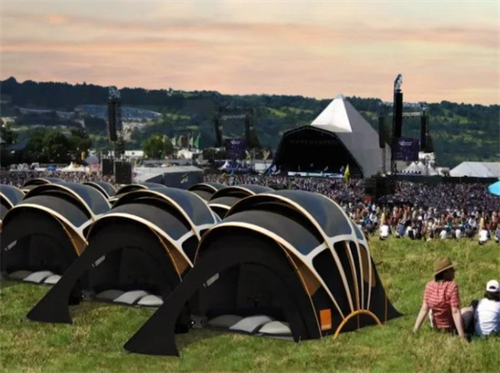
The main technical route right now is organic photovoltaics, usually called OPV. Unlike the rigid silicon panels most of us are familiar with, OPV materials can be made into flexible films and integrated into textiles like polyester.
PV Magazine ran a piece in June 2025 about a European project called Suntex. It's backed by Eurostars funding of roughly €2.13 million, and the goal is to embed organic thin-film solar cells directly into woven polyester fabric that can handle UV, rain, and general outdoor abuse. According to numbers released by the project, the textile weighs around 500 grams per square meter, and a 5-centimeter-wide strip can withstand 300 kilograms of tension. Sizes and weave patterns are customizable. The article also makes clear that systematic, independent data on efficiency loss after repeated folding and long-term UV exposure hasn't been published yet. That's a gap worth noting.
The same outlet covered a real-world deployment in October 2025: a temporary structure at Dutch Design Week called the Umbra Pavilion. It used a technical textile named Heliotex, with 150 OPV modules integrated into 8 square meters of fabric. The quoted output was about 53 watts per square meter, paired with a 3 kWh battery bank for nighttime lighting. It's one of the few publicly documented cases of this kind of textile being used outdoors.
Now, let's put those numbers next to what a regular portable solar panel can do. Current folding monocrystalline panels hit 22 to 26 percent efficiency. The Heliotex figure of 53 W/m² means you're getting roughly one-fifth of that, under the same sun.
Do the rough math: a two-person tent might have a usable top surface area of 3 to 4 square meters. In ideal sunlight, you're looking at maybe 200 to 400 watt-hours harvested over a full day. That's enough to keep a phone, a GPS unit, and a satellite messenger topped up. A laptop or a small heater? The numbers just aren't there yet.
For context, the American Composites Society ran a sustainable design competition in 2025. The winning portable solar tent concept set its performance target at a daily average output of at least 400 watts, with total system weight under 20 kilograms. That tells you something: even at the engineering competition level, juggling weight and power output is still very much an active problem.
There's also a separate, less obvious thread worth mentioning. The 2026 Red Dot Design Award featured a tent concept called DuneShift XT that uses a dual-mode photonic textile, supposedly inspired by the temperature-regulating skin of the Namibian chameleon. The idea is the fabric switches between solar heating and radiative cooling modes on its own, no external power needed.
But—and this matters—Red Dot judges design concepts and innovation, not off-the-shelf reliability. There's no production timeline and no independent durability testing publicly available yet. The concept is interesting because it suggests a different path: maybe future tents won't always need to generate electricity to manage temperature.
Self-heating jackets: what active warmth can actually do
Most heated jackets you can buy today run on battery-powered flexible heating elements. Two materials dominate the market.
Carbon fiber elements heat up fast—some brands claim three seconds to working temperature—and they're flexible enough to distribute warmth fairly evenly. Graphene has been gaining ground more recently. It conducts heat well, and some industry analysis suggests it can save about 15 percent on power consumption compared to carbon fiber. A few manufacturers have started blending graphene with merino wool, aiming for a mix of active heating and the breathability of natural fibers.
Battery specs from published product sheets tend to cluster around 8,000 to 10,000 mAh packs, good for 6 to 10 hours of heating in cold weather, depending on the heat setting. Higher-end models come with 20,000 mAh batteries and can reach maximum temperatures around 52°C. Most designs include a safety cutoff at 55°C, and the outer fabric is usually treated for water resistance and breathability.
But if you step back and weigh the whole system, the math gets messier. A 10,000 mAh battery pack typically weighs a bit over 200 grams—similar to a lightweight down jacket or a fleece. In other words, the jacket replaces one insulation layer, but the battery hangs roughly that weight right back onto your pack. The weight saving that gets advertised? A lot of it cancels out.
Then there's the failure question. Industry feedback and user commentary regularly mention battery degradation. Some packs lose capacity noticeably after a limited number of charge cycles, and the usable lifespan can dip below a year and a half. If the heating element or battery fails midway through a trip, and the jacket itself doesn't have much passive warmth, you've got a hole in your insulation system. That's why the more sensible approach right now is to treat a heated jacket as a supplement—not as a reason to leave the puffy at home.
Battery-free passive heating is a different story, and it's mostly still in the lab. In March 2026, the journal Advanced Materials published a study on a photothermal fabric that heats up under sunlight without changing color. Under simulated sunlight of 1,000 W/m², it showed a 4 to 8°C temperature rise within five minutes. The method uses a dip-coating process to embed narrow-bandgap organic semiconductors into the textile. The limitation is printed right there in the findings: it works during sunny daylight, not at night or under shade.
Another piece of research from 2025 demonstrated a 3D self-folding knit that can switch between radiative cooling and passive warming as body temperature changes, no battery required. The paper reported more than 1,000 cycles of durability across a temperature range from -20°C to 35°C.
Separately, a handful of outdoor brands now sell passive jackets that claim to use graphene's far-infrared reflective properties for extra warmth—TerraStorm being one name that pops up in media reports. But head-to-head, independent test data comparing these fabrics against traditional insulation of the same weight? That's still missing from the public record.
Where things might be headed in the next few years
Three threads are worth pulling on.
First, the market is growing much faster than the products are maturing. Straits Research sees the heated jacket market reaching about $886 million by 2034, at a compound annual growth rate of 9.50%. But industry analysis also points out that the number of companies actually making integrated photovoltaic fabrics remains small, and most of the R&D is aimed at wearables—tents and shelters are still a niche within a niche. For hikers, that means checking independent test results matters a lot more than listening to marketing language.
Second, there's a quiet push toward making gear talk to each other. A few trade-show concepts already play with the idea of linking a solar tent and a heated jacket into a single energy system: the tent charges the jacket's battery during the day, and the jacket's battery powers your phone or satellite device when heating isn't needed. This whole-system thinking hasn't hit consumer shelves in a meaningful way yet, but it's a useful lens. Evaluating one piece of gear in isolation might not tell you the full story if it's designed to work as part of a set.
Third, there are two specific numbers that would tell us more than any press release. One is the efficiency degradation curve of OPV fabric after real-world folding and prolonged sun exposure—not just lab-aged samples. The other is a proper third-party comparison showing how much warmth a battery-free thermal-regulating fabric actually retains versus traditional insulation of the same weight. Both data sets are still scarce. When credible independent testing finally shows up, that's likely the signal that these technologies are moving from "worth watching" to "worth packing."
FAQ:
Does a solar fabric tent generate enough power for a multi-day trek?
Based on published specs, an OPV-integrated tent roof might harvest 200 to 400 watt-hours on a good solar day—enough to keep a phone, GPS, and satellite communicator charged. Actual output depends heavily on weather, latitude, season, and tent orientation. Powering a laptop or similar high-draw device isn't realistic at current output levels.
Can a heated jacket replace a down jacket?
Not entirely. Active heating helps a lot when you're stationary, but it relies on battery charge and functioning electronics. Down insulation works without any power source. The more cautious approach is to treat the heated jacket as one part of a broader insulation system, keeping a lightweight puffy or fleece as backup.
How long does organic photovoltaic fabric last?
The Suntex project has shared mechanical strength data—a 5 cm strip can withstand 300 kg of tension, as reported by PV Magazine in June 2025. However, systematic independent assessment of efficiency loss after repeated folding and long-term environmental exposure hasn't been published yet. That remains a critical question.
Can I buy this gear now?
Battery-powered heated jackets are available through mainstream outdoor brands and online retailers. Solar fabric tents are still mostly found in professional or commercial settings—PV Magazine reported in October 2025 that Heliotex is aimed at commercial and institutional clients, while Pvilion's solar textiles have been used for events like Coldplay's tour. They haven't reached regular retail channels yet.
References
[1] Hille, S. "Suntex integrates organic PV into sturdy textiles for outdoor use." PV Magazine International, June 27, 2025.
[2] Thompson, V. "Textile integrated organic solar PV canopy provides shade, area lighting." PV Magazine International, October 24, 2025.
[3] Straits Research. "Heated Jacket Market Size, Share & Growth Report by 2034." October 2025.
[4] Wang, Z. et al. "Chromatic-Invariant Photothermal Fabrics Enabled by Narrow-Bandgap Organic Semiconductors for Wearable Solar Energy Harvesting." Advanced Materials, March 2026.
[5] Stratistics MRC. "Flexible Solar Fabrics Market Report." February 2026.
Disclaimer
This article is based on publicly available literature, industry reports, and academic papers as of May 8, 2026. All descriptions of product performance and technical parameters are drawn from published sources and do not represent the author's personal experience with or endorsement of any product. Outdoor gear decisions should take into account individual experience, trip conditions, and safety assessments. Backcountry environments are unpredictable; no piece of technical equipment can replace thorough route planning and sound wilderness judgment. Cited data may differ from real-world results, and readers should refer to the latest manufacturer information and independent testing.
Recommend for you:

Valbona–Theth Hiking Trail: Albania’s Most Scenic Single-Day Trek?
In the last few years, Albania’s “Accursed Mountains” have started showing up more often in hiking conversations.
Tajikistan’s Fann Mountains: An Untouched Trekker’s Dream
For hikers who have already done a hut-to-hut traverse in the Alps or a few standard circuits in Nepal, the question of where to go next is shifting.
Sweat-Powered Wearables: The Next Frontier in Off-Grid Charging
Few hikers talk about it, but one slow-burning frustration hits hardest on long trips: battery anxiety.
"Wearable Coach": Can a Smartwatch Really Replace a Mountain Guide?
You've probably noticed it. Over the last few years, the way outdoor watch brands talk about their stuff has changed. It used to be about tracking—distance, elevation, heart rate.